10/26/21

A humid, 95 degree day. Really takes the energy out of you. I taught, took my clothes to the laundromat, and did some work for my online class about data analytics.

The Word for World is Forest by Ursula K. Le Guin is roughly a hundred and eighty pages (with big text), and reading it felt like a breeze compared to Gravity’s Rainbow, the last work of fiction that I finished. TWFWIF is science-fiction novel about the conflict between the natives of the planet Athshe and a group of technologically-advanced human colonists (think James Cameron’s Avatar, but with small, green aliens instead of big, blue aliens). The plot is pretty standard fare; it’s one of many anti-colonial sci-fi stories created in the aftermath of the Vietnam War. It seems Americans could only sympathize with the plight of the Vietnamese if we imagined them as literal aliens.

Where TWFWIF shines is its prose. Le Guin presents us with a number of perspectives, each written in a simple style that prizes emotional clarity. The highlight of the book is its villain, a delightfully- hateable human general with a vitriolic contempt for the passivity of the Athsheans and the perceived weakness of any humans willing to compromise with them. The chapters from his perspective are viscerally upsetting in a manner which is very fun to read.

On the other hand, I didn’t care much for the aliens. Le Guin’s depiction of the Athsheans was utopian in a way that came across as paternalistic. The trope of the spiritually-enlightened, perfectly-innocent natives is an oversimplification that avoids all the difficult questions about colonialism.

In sum, The Word for World is Forest was a fun and fast-paced read, but the subject matter feels pretty well-trodden and I don’t think Le Guin had much new to say. Perhaps a longer version of this same story would have been better. 6/10

10/25/21

I was informed today that there will be no classes this Friday. This would have been nice to know earlier; I’m going to have to rearrange some things this week. All of my classes are discussing Halloween; the plan had been to have students give presentations on Thursday and have a fun day on Friday, but this will clearly no longer work.

After my classes I caught up with a friend for about an hour on the phone. He’s also been working remotely, and we talked a lot about what that’s been like. I’ve been using my phone and computer a lot more since arriving in Mexico and starting this job (Apple says I’m averaging about eight-and-a-half hours of screen time every day) and lately I’ve been thinking a lot about what it means to be living online like this. It’s probably not great for my brain, but it’s also probably going to become more and more common for a lot of people. I want to write more about this, but grades are due this week and I’ve been planning my trip to Mexico City this Saturday, so I’m pretty exhausted right now. I’ll try to write more tomorrow.

10/24/21

Today I woke up at noon, planned out some Halloween lessons, did a bit of planing for my upcoming trip to Mexico City, and finished Freud’s Civilization and its Discontents, which I had started yesterday. Freud’s ideas are often made fun of (and not without good reason), but I had also seen him referenced in enough places that it seemed like something I should familiarize myself with. Now, having read some of his work, I would put him in the same category in which I put Plato: his ideas are mostly wrong, but they are wrong in very thought-provoking ways. This particular book concerned the ways in which the creation of peaceful society requires the repression of individual desires; sometimes this repression is external (ie cops), but as civilization advances, this repression is increasingly internalized by the individual, where it expresses itself in the form of guilt (I think this conclusion is generally true; where I differ with Freud is in nearly all of the specifics he brings to his argument). I intend to read another one of Freud’s short works, Beyond the Pleasure Principle, later this week, and perhaps I will give a longer review there. I also still need to review The Word for World is Forest, which I finished a week ago.

10/23/21

Today’s Reading Club selection was a translation of an English story, Adventure by Sherwood Anderson, about a girl who watches her youth waste away as she awaits the return of a childhood crush. It’s a sad story, but worth reading. I’ve linked the English version above; it’s only six pages long.

In the afternoon, I went to see Dune at the movie theater in Tuxtla (technically, I saw Duna, the Spanish-dubbed version). Dune is one of my favorite books, and the things I like about the book are impossible to capture with the medium of film (There’s a David Lynch adaption from 1984 that’s horrendous), so I knew I would be disappointed by the movie somehow, nonetheless, I was excited to see how they would try to adapt it.

The highlight of the film was that I could understand it, even in Spanish. This is a compliment both to me and the director. The book Dune includes a lot of complicated world-building; there’s a glossary in the back of the back that’s essential to reading. This is part of what makes it such a difficult adaption. The 1984 Dune failed (in part) because it couldn’t figure out how to explain everything via film. There’s a lot of voiceover, but the movie still ends up being completely incomprehensible. The 2021 version is being split into two movies, and the result is much more coherent. I think the greatest success of the movie is that you could probably follow the plot without having read the book.

All that said, I was still disappointed by the movie. Despite a two hour, thirty-five minute runtime, and a proposed sequel, the pacing still felt rushed. Scenes never lasted more than a minute. Characters would enter a room, say a few words to move the plot forward, and the film would cut to a different location. The design of the world was super cool (probably my favorite thing about the movie), but you never get to spend enough time in any particular location for it to feel significant.

Related to the problem of pacing was that of sound. The whole film feels like it was edited around the Hans Zimmer score. Not a single scene goes by without frantic chanting or a crescendo of brass. The soundtrack is cool, but it never lets up, and the lack of contrast grows boring. What was lacking were the quiet moments that give the loud moments meaning (“a true artist respects the silence…”). The result was a project that felt more like a really long music video than a movie.

Visiting the dunes of the Sahara desert remains the most sublime experience of my life thus far. At night, the endlessly rolling hills of sand call to mind the waves of the ocean, but one is struck by the absence of movement or sound. The overwhelming sensation is that of stillness. In two-and-a-half hours, mostly set in or near the desert, Dune was unable to capture this. Every moment was one of maximum tension: Big battles! Blaring music! Constant motion! The book’s themes of self-control and transcendence were lost in the noise. Dune 2021 has some very cool-looking spaceships and battles, but the things I loved about the original story were the conversational subtleties and nuanced political intrigue. The film’s blockbuster impulses drowned out anything unique it had to say. 5/10.

10/22/21

Tayde brought a zapota to our Friday breakfast, so I got to try a new fruit. The zapota looks like a big potato, tastes like a date, and has a core made of chicle (the stuff gum is made of). It’s pretty weird to eat an exotic fruit that essentially has a stick of gum in the middle. I think of gum as a hyper-processed, unreal quasi-food, but also as something incredibly commonplace. Zapota, on the other hand, is totally natural, but completely alien to me. Eating zapota for the first time was an exercise in cognitive dissonance: I know that this is a real fruit, that grows on trees, that people have been eating for thousands of years, but I still can’t help but think of it as an imitation of gum, rather than the other way around. Ultimately, the flavor wasn’t great, but it made a highly thought-provoking breakfast. 4/10 fruit, 9/10 experience.

In the afternoon, I taught a Neil Gaiman story (Click-Clack the Rattlebag) that had been suggested in the comments here like two months ago, so thank you Britt, if you are still reading. I appreciate it, and I think the students did too.

10/21/21

I finished another book today (The Word for World is Forest by Ursula K. Le Guin), so I need to write up a review of Gravity’s Rainbow, which I finished last week, otherwise I will fall behind. My day was otherwise pretty normal.

Gravity’s Rainbow by Thomas Pynchon is a big book. My copy has 776 pages. The novel takes place during the end of the Second World War, and (loosely) follows the increasingly paranoid behavior of an American soldier named Tyrone Slothrop, his surveillance by a shadowy intergovernmental agency, and the possible connection between his erections and the falling of the Nazi V2 rockets. It is a spectacularly odd book, often devolving into bizarre tangents on topics ranging from calculus to the extinction of the dodo bird.

At its best, the book’s sprawling ambition captures a sense of impending dread about the transition from the late-industrial to information economy. Characters are trapped in huge, interlocking systems of power, over which they have no control, and seemingly neither does anyone else. There is a great tragedy in their lack of agency. Characters do bad things, and know that they are doing bad things, and understand the forces which are driving them to do bad things, but are still unable to do anything else. Increased access to information has heightened our gaze but not our grasp. Today’s world is simultaneously more visible and less tangible than ever, and the result is an endlessly-escalating paranoia.

Despite the gravitas of its subject matter, the book is quite funny. Yes, the prose is often pretentious, but there’s also a chapter about being sexually aroused by eating shit. There’s a lot going on, and Pynchon does a remarkable job of holding it all together, at least for the first three quarters of the book.

That said, I have mixed feelings about some elements of the book. The ending is a bit of a mess (albeit intentionally). The last hundred pages or so takes an increasingly postmodern turn, matching the mental breakdown of its characters with a heightened narrative instability; skipping across space and time, blending hallucinatory and real. There are good thematic reasons for doing this, but the result was that the ending was the most-difficult, least-enjoyable part of the book.

My other big problem was the characters. There’s something like a hundred characters in this book and none of them have any distinguishing features beyond their wacky names. Once again, there are solid thematic reasons for this; characters are defined not by their internal qualities, but by their circumstances. They are identical pawns, differing only by their position within the system, trapped by the accident of their births. Sometimes this was very poignant. Other times, it felt kinda difficult to get through a nearly-800-page book when there aren’t any memorable characters. The book has emotion, but it is always a God’s-eye, top-down sort of pathos, never anything personal or intimate. The characters are agents for the plot, nothing more.

In sum, the scope of Gravity’s Rainbow is incredible. Its ambition largely succeeds, and the grandeur of its scale allows it to invoke feelings that other books are unable to articulate. It is the sort of book that bleeds into your waking mind throughout the day; to read the whole thing is to live with it for months, to internalize its lenses and see the world anew. It’s definitely not for everyone, and I can understand why someone could read thirty pages, hate it, and give up. The book is unconventional, and it is not without flaws. That said, even though it wasn’t my favorite book ever, it does represent, for me, the high-water mark for a certain kind of fiction. Give it a go if you’ve got some months to spare.

10/20/21

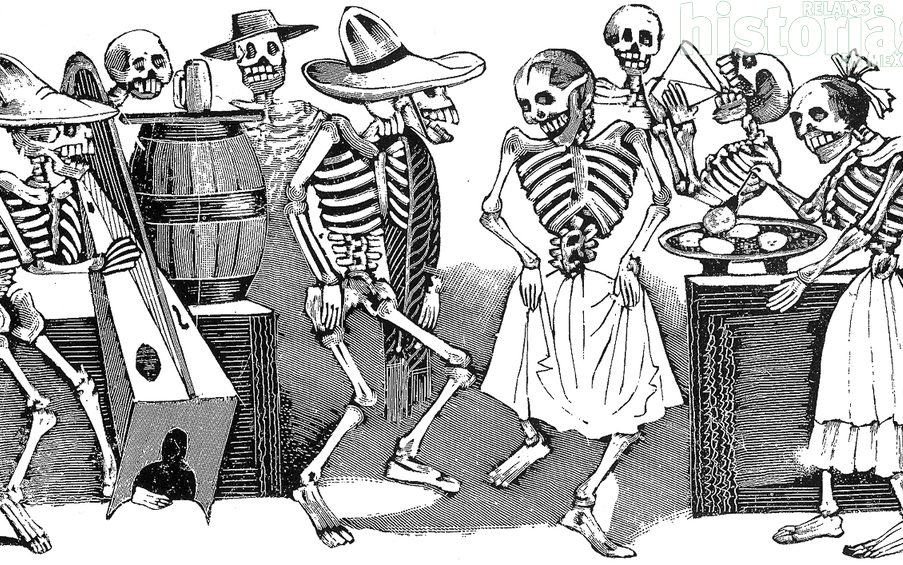
In my morning Spanish class, Tayde brought in a bunch of books about anthropology and art and we talked about the role of death in Mexican culture. I can’t yet fully articulate it, but there is a strong cultural difference in the way Mexicans and US Americans think about death. Death is a bit more present here; it isn’t as taboo as it is in the US. People visit the graveyard fairly frequently, and Dia de Muertos is a big holiday (technically two days) for remembering and celebrating the dead. In Mexican artwork, the skeleton is a sort of national mascot and appears in works throughout the past century, but in a sort of satirical way. A lot of famous Mexican novels are about ghosts. Comparatively, it seems like US culture doesn’t really talk about death much, and I think that makes it harder deal with when it inevitably arrives. I’ll probably flesh out (ha!) these ideas more in the coming weeks. Dia de Muertos is coming soon (November 1 and 2).

After classes today, Sherrill, Luzma, and I went to Gina (the school directors) ‘s house to celebrate San Sebastian’s Day. To the best of my understanding, San Sebastian’s Day is not a day, but the 20th of every month, plus like two-and-a-half weeks in January. I’m still not sure what he did to receive so many holidays, but it must have been pretty cool. Gina and her family live in a large house, on what is essentially a good-sized park. Several generations of their family are involved in business law. Upon arrival, we were ushered into a small church (on their yard), where the family and their friends recited a bunch of prayers. Somehow Sherrill and I ended up in the front row, clueless. After that we had quesadillas and hot chocolate, with Gina, her husband, and Ginita, although it seemed the family had already eaten before we arrived. Gina’s two youngest kids (Xavier and Rodulfo) are in my classes, but they were acting shy; both had friends over and seemed confused to see me in person (fair enough, they’ve previously only seen me in Zoom). We chatted with the older family members for about two hours, then left. All in all it was a nice time. I can’t always keep up with the speed of the conversations in Spanish well enough to chime in, but I can understand the gist what’s going on and laugh at the appropriate times.

10/19/21

This morning, Chibi the cat scratched my hand because I took the notebook he was sleeping on. I understand his anger, but I think the real culprit here is the subjunctive tense. If there weren’t so many goddamn verb tenses, Chibi could sleep on my notebook all day and we wouldn’t have any problems.

10/18/21

Today was a fairly normal day. My beginner class is slowly learning to put their adjectives before the nouns they describe. Advanced class is learning how to talk about cooking. Conversation class is learning about money this week; today we talked about how banks work. I talked to the guy at the hotel again, he asked why the US keeps starting wars that they don’t (can’t) win, and then invited me to go talk to girls in the park with him tomorrow. I feel pretty weird about this (especially because he’s like ten years older than I am) but maybe that’s what people do for fun around here. It is a small town. I’ll decide tomorrow whether or not to join him.

10/17/21

I went to bed early last night and woke up late today. Probably slept 15 hours. Spent the afternoon reading and planning lessons (grades are due this week too), then called a friend in the evening. There’s a big, dry spot on my foot where the skin has been cracking and peeling for several weeks now, and I’ve been putting lotion on it several times a day, but it doesn’t seem to be helping.