I tried to post these more than a week ago and I’m just now seeing that they never uploaded

A blog by Adam Fendos
I tried to post these more than a week ago and I’m just now seeing that they never uploaded
Happy Thanksgiving! It’s been a while since I’ve written, so I’ll do my best to catch everyone up. This will also be a test of my own memory.
Last Friday, we went out for dinner to celebrate the back-to-back birthday’s of Sherrill and Ginita (who are now 78 and 22 respectively) with Luzma and mom Gina. We ate at the same restaurant we had visited for our welcoming dinner roughly three months ago, and I was startled by how much my Spanish comprehension has improved since then. I ate until I couldn’t, and then was peer-pressured into eating some more.
On Thanksgiving, I took a bus to Tuxtla to eat KFC at the mall; this was as close to a traditional American Thanksgiving dinner as I could find. It was here I discovered that the KFC slogan, “finger-licking good” has been translated into Spanish as “para chuparse los dedos”, which, when translated back to English literally means “to suck the fingers”. I don’t like this. Later, I was able to video-chat with everyone at my family’s Thanksgiving celebration, which was nice, though it was a bit overwhelming to be passed back and forth amongst so many people. I am continuously thankful that despite the ostensible distance, my family and friends are never more than a phone-call away.
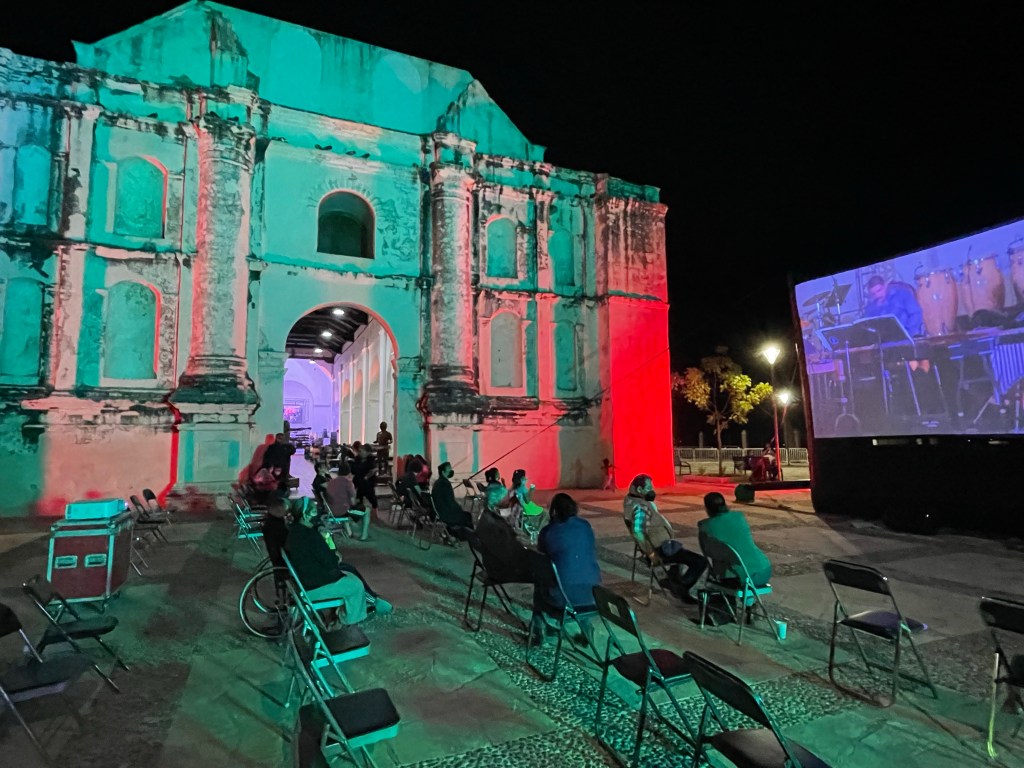
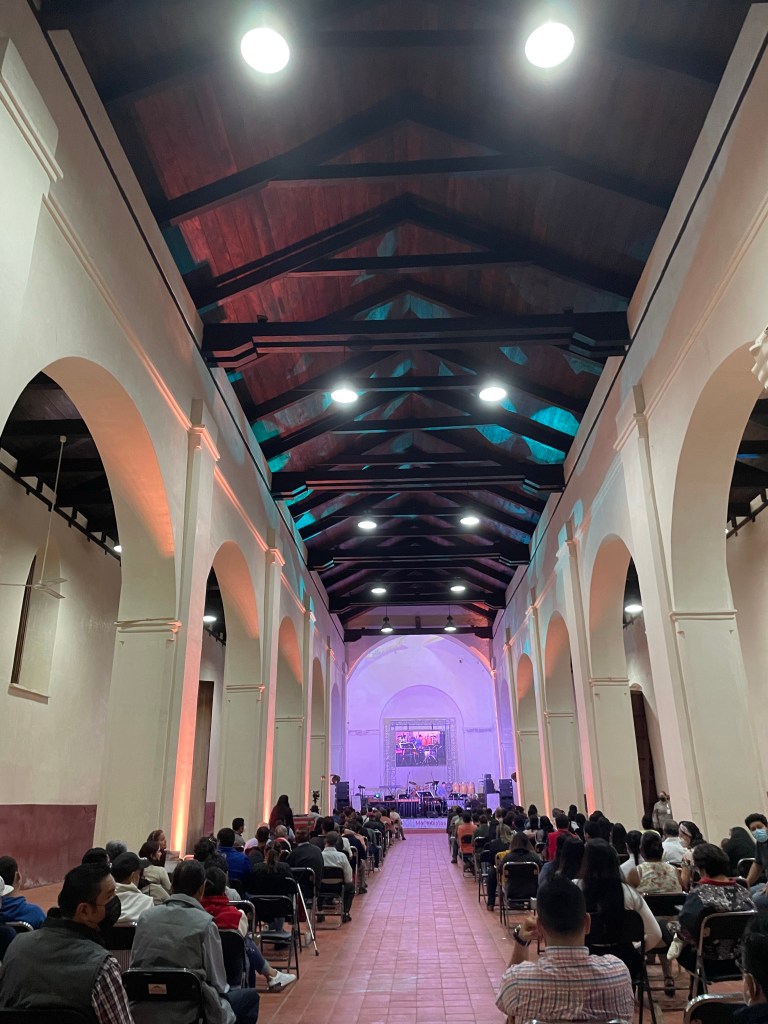
Yesterday, I was talked into attending the 21st annual International Marimba Festival. I’ve developed tinnitus over the past year and a half (probably from making music on my computer and going to lots of concerts), so I try to avoid places with loud music, but Luzma was insistent. We walked to a neighborhood I hadn’t yet visited, climbing a big hill to find ourselves in a recently restored Church wherein a concert titled “Avant-Garde and Microtonal Marimba” was taking place with damn-near the entire town in attendance. My host parents were there, the women from the cultural center where Tayde and I hold Reading Club were there, the girl I went on a date with two weeks ago and then ghosted (it was mutual) was there; everyone. After some sick microtonal jams, a second band played (the same one that had played for Sherrill’s class at the marimba museum), then Luzma and I got tostadas and I headed home.
It’s been a couple of days. Here’s an update. On Friday, we were informed that there would be no classes this Monday. This information would’ve been nice to have several days prior. At this point, I’ve kinda given up on trying to anticipate the schedule (for what it’s worth, we were given a school-year calendar when I first arrived, but 1. we’ve already made several departures from the scheduled dates, and 2. the calendar is color coded but was printed without blue ink, making it pretty much impossible to decipher anyway).
During Saturday’s reading club, I was finally able to get a copy of Tayde’s short stories. It’s been more than a month since she first mentioned them, and I’ve been very curious. There’s are seven stories and I’ve only read one so far, so I haven’t drawn any conclusions yet, but I’m excited to read more. Progress on my own short stories been difficult and slow. Coming up with ideas is hard enough, but I have no idea how to write characters.
Saturday night, I had a date with a girl I had met on Tinder. It was an okay time. We met in the park, got dinner, and then returned to the park to watch the clown (who I learned is named Kooky). It was the first time I’ve had been on a date entirely in Spanish (the girl I met in San Cristobal spoke English pretty well) and I feel like that made it hard to connect. I was able to hold a conversation, but it felt like I was just running through ice-breaker questions without hitting on any common interests. She seemed like a nice person, and I felt bad for feeling bored. We probably won’t meet again.
Later, on Monday, I informed the school here that I will not be returning for another semester. Instead, I will be moving to Shanghai this February (I didn’t tell them that). I feel a bit bad about changing my mind after saying I would stay, but I think this is the best decision for me. Chiapas is nice, but the town is small and it’s been hard for me to meet people. Shanghai is the second-largest city in the world, and with that comes a lot of opportunities that I just can’t get here. It’ll also new challenges (like learning Chinese), but I’m feeling up to the task.
That’s about it for today. Not sure when I’ll post next, but I’ll try to keep it soon-ish. I’ve been thinking writing a weekly personal update and a weekly topical essay. No promises though. We’ll see how it goes.
Day 100! Crazy. Things were more or less normal. I helped Sherrill set up her new phone, which wasn’t too bad, but I swear she managed to buy the slowest model they had. I also completed my homework for my Data Analysis in the Humanities course; I think there are only two weeks left.
On Saturday I finished Power/Knowledge by Michel Foucault. Foucault was a French philosopher and historian who wrote a series of books about the relationship between power and particular knowledge-producing institutions, including the psychiatric clinic, the hospital, and the prison. As a whole, his work attempts to define a shift that occurred in the 18th and 19th centuries, whereby the surveillance and hierarchical discipline gradually replaced direct violence as the primary means of administering power. In June, I read his most famous book, Discipline and Punish, which charts the progression of the criminal justice system from public executions to invisible condiment.
Power/Knowledge is a collection of lectures and interviews, which provided an illuminating look into Foucault’s thought-processes and methodology. The writings in the book primarily concern what Foucault calls “regimes of truth” or “epistemes”, ie the cultural and political rules which govern what can be considered true or false. This goes beyond just political correctness; the rules of the episteme determine what thoughts are even possible. For example, microorganisms (ie germs) were not discovered until the mid 1600’s when microscope technology progressed far enough to make them visible. Prior to this discovery, it was logical enough to blame one’s illness on demons or bad spirits. The discovery of germs, then, marks not just a change in technology, but in subjectivity. A person who lives in a world of demons must think and act differently than a person who lives in a world of germs. Thus, in proving the existence of germs, we fundamentally alter the way we view ourselves and the world in order to open new doors of thought and gain greater power over life. There are also political consequences to this shift. Replacing the concept of sickness-by-demon with the concept of sickness-by-germ strengthens the ideological regime of the medical profession at the expense of the Church. These sorts of epistemological shifts are what Nietzsche is talking about when he refers to the “death of God”.
The lectures and interviews that make up Power/Knowledge describe the emergence of concepts such as madness, criminality, and sexuality, and examine the ways in which these conceptual frameworks have been used and developed for political ends. The book posits that the production of truths is both historically contingent and politically motivated; the complex concepts in our head are not the products of objective reality but of institutional powers, and those institutional powers have economic interests. That doesn’t necessarily make the truths less true, but it does mean that some truths are promoted while other truths are suppressed, and that we are so caught up in this economy of knowledge production that there is no such thing as an objective or non-ideological position from which we can observe the world free from bias. Science is said to be objective because it merely describing things as without making claims as to how they ought to be, but any description of a phenomena involves a normative judgement (sometimes not even conscious) about which phenomena are important enough to be included in the description, and thus there always remains room for ideology to obscure truth.
On an unrelated note, I’m going to take some time away from the daily blog for a bit. I’d like to try writing some short stories instead. I’ll still write updates when something noteworthy happens, but in the meantime, I have a lot of bubbling anxieties about the future that can only be explored via science fiction.
Today, I arrived at the school, ready to teach my classes, only to find out that the school’s internet had been down all afternoon (it had also been having problems yesterday morning, but it hadn’t affected me because the problem was fixed by the time my classed started). Making a judgement call, I returned to my house, and was able to hold my classes only a few minutes late. I have no idea what Sherrill did, or if the internet ever came back (Sherrill lost her phone about two days ago and just bought a new one today, but couldn’t set it up because of the lack of internet [her apartment uses the same modem as the school]. Luckily, she’s old, and thus seems generally able to function without a smartphone in a way I struggle to imagine for myself. Assuming the internet is functioning properly, I’ll help her set the new phone up tomorrow). Some of my students were absent and it sounds like many cafes lost internet yesterday too, so I think it may be a town-wide issue with the service provider.
This brings me to a broader point about online classes, which is that without reliable internet, they can be next to impossible. Students will drop in and out of class, sometimes mid-sentence, as their connection comes and goes. Audio quality is hit-or-miss and there are some kids who I just can’t hear. Furthermore, for many students, turning the cameras on causes their sound to lag, so I end up looking at a bunch of grey rectangles with no idea whether or not they are comprehending what I say, or if they’re even in the same room as their computer, unless I specifically call on them for an answer. The whole process of online teaching is alienating enough when it works properly; on days like today when there are technical difficulties, just getting to the end of class feels like a monumental task.
On an unrelated note, WordPress tells me that today will be my 99th consecutive day of posting. I’ll write again tomorrow, because 100 is a satisfying number (and because I still need to review Foucault), but after that I may ease back on the daily posts. I think they’ve gotten a bit repetitive and I’d like to branch out to something more narrative and literary. Maybe that will end up published here, maybe it won’t. Maybe I’ll stop writing entirely and then feel bad about it and resume the daily posts two weeks from now. But I think that after 100 days, some amount of change is needed. I wouldn’t want things to get stale.
Monday:
My Beginner class is learning how to talk about feelings this week, which means we mostly talked about dogs. Being with dogs make them happy. Seeing abandoned dogs makes them sad. Getting a dog makes them excited. Simpler times.
Advanced class is learning about household items; Conversation class is learning about cooking. No dogs there.
Later, I explained (for what must be the thirtieth time) that “soup” has a U sound. The Spanish equivalent, “sopa”, has a long O sound, and as a result, multiple students from all three of my classes keep telling me that they love eating soap. It happens at least once a week. We had a similar discussion about sweets and sweats last week (on a somewhat-related tangent, I’ve been talking to a girl on Tinder who’s name is Sweet [which presumably a nickname], but there’s a non-zero chance that if I meet her, she will tell me her name is “Sweat”, and I’m not quite sure if/how to address this if it comes up…).
As a side note, I did finish my Foucault book on Saturday and will have a review up later this week, just as soon as I can think of something original to say about it. I haven’t forgotten.
Today, while eating lunch, a weird, shimmering spot appeared in my vision, slowly expanding until it became difficult for me to see clearly. This was mildly concerning, but after some googling, it seems that I probably had an ocular or visual migraine, which is harmless; however, it took a while to figure this out, because all of the words on the page had a sort of shifty, dreamlike quality and kept changing whenever I wasn’t focused on them. It wasn’t accompanied by any pain and went away in less than an hour, but it was the strangest thing that’s happened to me in a while.
Other than that, I just slept in, made some lesson plans, and read a bit. A pretty unexceptional Sunday, weird vision stuff notwithstanding.
I didn’t really understand the story we read in Reading Club today, but it seems neither did the other girl who was there, and Spanish is her first language (though admittedly she’s probably 6 or 7 years younger than me) so that made me feel a bit better. After some more reading (this time in English) and a nap, I completed my application to a research position at the International Crisis Group, which included a link to this blog, so now I have to write extra well for the next couple of days in case they decide to drop by (if you’re reading this and you work at the ICG, hello! I’d be a really good intern, I swear. The past week of posts are mostly about my visit to Mexico City, but if you go back roughly two weeks, there are some book reviews and cultural analysis as well). The application also requested a writing sample, which led me down to reread a bunch of my old college essays. The one that I submitted was about the development of international war crimes courts (a topic which is probably too niche to be of interest to most of the people who read this blog), but I encountered some other essays that I might rework and publish here. An essay on the history of the word “fuck” was particularly fun, and still mostly holds up, despite the fact that I wrote it almost five years ago.
I’ve also stepped up my scramble egg game this week (it’s really the only food that I cook) after being informed that letting the pan heat up before you add the eggs actually keeps them from sticking. This absolute game-changer inspired me to get fancy with it, and today I added tomato and an onion too. I might even try adding an avocado tomorrow, if it’s ripe by then.
I’m going to cut it short because I have about thirty more pages left in my book (the afterward to a collection of essays, speeches, and interviews by the philosopher/historian Michel Foucault) and I’d like to finish tonight. Expect a review sometime this week, though God only knows how I’ll summarize Foucault. We’ll cross that bridge later.
A student in my beginner class told the following joke today:
“If ‘car’ means ‘carro’ and ‘men’ means ‘hombres’, is Carmen a transformer?”
This might be the worst joke I’ve heard in my whole life. At the same time, for an eight-year old in a second language, it’s pretty clever. I’ve been thinking about this all day.
I don’t really have anything to write about today. My English classes were mostly reviewing old material, though I’m also trying to introduce a new website that will allow us to do more writing activities. In my free time, I’ve been reading a lot about neuroscience/psychology/psychoanalysis this week, but not enough to have anything to say quite yet. I’m going to think for a while, and maybe I’ll write a long post tomorrow.
 AdamFendos.blog